.svg)


Interview multiple candidates
Lorem ipsum dolor sit amet, consectetur adipiscing elit proin mi pellentesque lorem turpis feugiat non sed sed sed aliquam lectus sodales gravida turpis maassa odio faucibus accumsan turpis nulla tellus purus ut cursus lorem in pellentesque risus turpis eget quam eu nunc sed diam.
Search for the right experience
Lorem ipsum dolor sit amet, consectetur adipiscing elit proin mi pellentesque lorem turpis feugiat non sed sed sed aliquam lectus sodales gravida turpis maassa odio.
- Lorem ipsum dolor sit amet, consectetur adipiscing elit.
- Porttitor nibh est vulputate vitae sem vitae.
- Netus vestibulum dignissim scelerisque vitae.
- Amet tellus nisl risus lorem vulputate velit eget.
Ask for past work examples & results
Lorem ipsum dolor sit amet, consectetur adipiscing elit consectetur in proin mattis enim posuere maecenas non magna mauris, feugiat montes, porttitor eget nulla id id.
- Lorem ipsum dolor sit amet, consectetur adipiscing elit.
- Netus vestibulum dignissim scelerisque vitae.
- Porttitor nibh est vulputate vitae sem vitae.
- Amet tellus nisl risus lorem vulputate velit eget.
Vet candidates & ask for past references before hiring
Lorem ipsum dolor sit amet, consectetur adipiscing elit ut suspendisse convallis enim tincidunt nunc condimentum facilisi accumsan tempor donec dolor malesuada vestibulum in sed sed morbi accumsan tristique turpis vivamus non velit euismod.
“Lorem ipsum dolor sit amet, consectetur adipiscing elit nunc gravida purus urna, ipsum eu morbi in enim”
Once you hire them, give them access for all tools & resources for success
Lorem ipsum dolor sit amet, consectetur adipiscing elit ut suspendisse convallis enim tincidunt nunc condimentum facilisi accumsan tempor donec dolor malesuada vestibulum in sed sed morbi accumsan tristique turpis vivamus non velit euismod.
A bit hidden under the more hyped long-term strategic aspects of AI, the fintech rise, and the growing potential of stablecoins, two major banking reports - McKinsey's "Global Banking Annual Review 2026: Precision with Speed" and Accenture's "Banking: The Future Is Back" - are looking at another fundamental question: where should banks actually choose to scale?
Both reports independently arrive at the conclusion that the answer has changed. For much of the last two decades, the aspirational model was"more" - more geographies, more business lines, more products, more customers of every type. Both reports now argue that this aspiration is not just outdated but actively dangerous. Scale still matters enormously - arguably more than ever with the growing IT investment requirements to address long-term strategic trends - but undifferentiated scale does not.
The winning banks of the next five years will be the ones that make sharp, deliberate choices for capital allocation along two axes: retail versus corporate banking, and global versus regional reach.
Why Scale Is Winning Bigger Than Ever
Start with the evidence that scale genuinely matters. Accenture's analysis of the world's 100 largest banks by assets found something striking: in most countries, the single largest bank by assets also carries the highest price-to-book ratio in that market. That's not a coincidence - it's investors explicitly pricing scale as a source of durable advantage, independent of anything else the bank is doing strategically.
The mechanics behind that premium are straightforward. Large banks access more diversified funding, including "stickier" institutional deposits and near-free money sitting in retail checking accounts. They borrow more cheaply because markets treat them as too big to fail, which lowers their perceived credit risk. They can absorb larger, more complex transactions that generate outsized fees. And critically, in an industry now being reshaped by generative AI, they can spread the enormous fixed cost of new technology across a far larger customer base - a cost advantage that compounds every year AI investment requirements keep rising.
Retail or Corporate - Where is Scaling more Profitable?
On a first glance commercial banking appears attractive to scale. The revenue pool is much larger - commercial banking (including large corporates and small and medium enterprises) $1,004 billion in FY2023, or 44% of total revenue across the top 100 banks, versus $888 billion (39%) for consumer/retail according to Accenture’s data analysis.
The same goes for pre-tax profit. In dollar terms, the 100 largest banks earned $368 billion in pre-tax profit from consumer banking against $499 billion from commercial and C&IB, showing not only a larger revenue pool but also higher profitability.
But the picture flips when you look at ROA. Retail banking generates a 1.5% return on assets, nearly double commercial banking's 0.8% ROA. Wealth and asset management does even better on margin, at 1.4% ROA on a much smaller revenue base. So retail converts investments into profit much more efficiently.
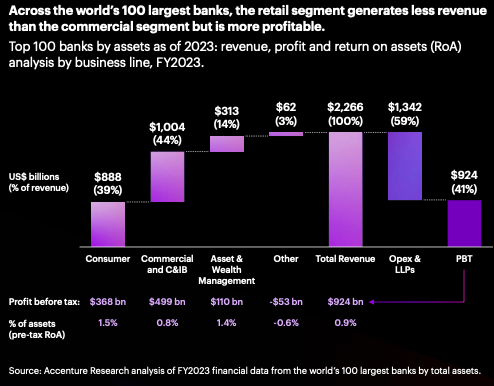
Accenture is explicit about why this split exists. In retail banking, the decisive factors are brand strength and the ability to scale technology across local, national, and international deposit and payment infrastructure - fundamentally an economies-of-scale game, where fixed technology and compliance costs get spread across a huge customer base.
In commercial banking, the decisive factors are relationships, deal size, and access to low-cost capital - a game that rewards depth of client relationship and balance sheet strength more than sheer customer count.
JPMorgan Chase's segment data illustrates the gap concretely: despite being renowned for its commercial and investment banking franchise, its consumer and community banking unit has posted an average return on equity more than twice as high over the past eight quarters.
Global or Regional - The Death of theUniversal Bank
The second axis is geographic, and the global universal bank is disappearing, and the data shows it happening in real time.
In 2005, ten of the world's twenty largest banks by market capitalization were genuine global universal banks. By 2015, that number had fallen to six. By 2025, it was down to just four. Major institutions have retreated deliberately: HSBC has reduced its presence in several markets; Citi sold its consumer businesses across 13 markets spanning Asia, Europe, the Middle East, and Africa, choosing instead to refocus on a narrower set of priority regions. The top of the market-cap league table is now dominated by banks focused on their home country or its immediate neighbors = not institutions chasing global reach for its own sake.
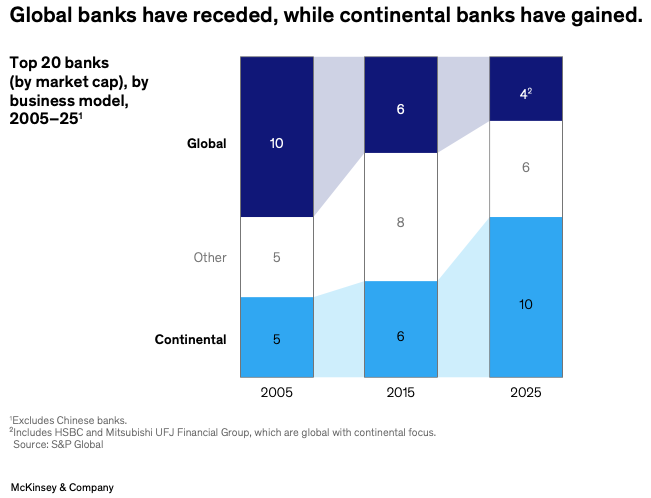
Accenture's report offers a useful historical explanation for why this retreat happened, even though its focus is different (Accenture's Trend 3 is about scale broadly, not global reach specifically). In the pursuit of economies of scale before the 2008 financial crisis, some banks convinced themselves they could be "all things to all customers" and expanded operations across most parts of the globe.
The result was often sprawling, difficult-to-manage organizations with sub-scale operations in numerous individual countries and segments - a phenomenon that came to be known as "diseconomies of scope." Over the following 10–15 years, many of these banks changed strategy, divesting non-core assets and subsidiaries to correct course. Global reach, in other words, wasn't a strategic asset in itself - it was only valuable where a bank could achieve genuine, defensible scale within each market it entered, and most banks that tried to be everywhere ended up strong nowhere.
What replaced "global": continental or transnational banking
What replaces the old global-universal-bank model, in McKinsey's telling, is "continental" or transnational banking - expansion that stays within a coherent regional or cultural cluster rather than spanning the globe indiscriminately.
DBS has expanded outward from Singapore with the explicit aim of building a pan-Asian network. Hungary's OTP Bank has grown fast by expanding across Eastern Europe and Central Asia. BBVA has evolved into a genuinely multicountry group spanning Spain, Mexico, South America, and Turkey - geographically dispersed on a map, but coherent in terms of language, regulatory familiarity, or economic linkage. Tellingly, wholesale banking remains the one business line that stays genuinely global almost by necessity - but it represents only about 11% of total industry revenue, meaning it's far too small a base to justify a truly global retail or commercial footprint on its own.
Scale still needs a geography attached to it
Accenture's findings on scale complement McKinsey's regional analysis by making the "where" question concrete for the near term, market by market. In retail banking specifically, Accenture expects scale to keep driving consolidation, but the mechanism differs meaningfully by region: continued M&A activity in the United States; both in-country and cross-country mergers in Europe, which will increasingly test the limits of the EU's fragmented sovereign deposit insurance framework; and a "planting flags" strategy for scaled regional players across Asia-Pacific, where the market remains more fragmented. In commercial banking, Accenture argues the more important move is owning transaction banking specifically, as regulators and capital markets continue pushing traditional lending off-balance-sheet and into the hands of non-bank credit funds.
Accenture's practical recommendation distills this into a genuinely usable strategic filter: agree explicitly on the specific segments and geographies where a bank actually intends to dominate, then commit real investment to achieving scale in each - including, where appropriate, using M&A to consolidate around a single scaled brand rather than running multiple sub-scale operations under different names. Where a bank's presence in a market or segment is genuinely sub-scale and unlikely to reach a defensible position, Accenture's advice is blunt: divest, or partner with a locally scaled player instead of continuing to prop up an operation that will never earn its cost of capital.
Why the Two Choices Are Actually One Choice
Read the two axes together, and a more interesting pattern emerges: retail-versus-corporate and global-versus-regional aren't really independent decisions - they reinforce each other, and the reports' regional data shows this clearly.
Retail banking's economics are fundamentally a scale-and-technology game - brand strength and the ability to amortize fixed technology costs across a large, geographically coherent customer base. That means a retail strategy only works at genuine regional scale; a retail franchise scattered thinly across a dozen unrelated countries captures almost none of the economics that make retail attractive in the first place. This is precisely why McKinsey's most successful examples of geographic expansion - Nubank in Latin America, DBS across pan-Asia, Revolut and Nubank's broader neobank breakout -0 are retail-and consumer-led plays built around culturally or economically coherent regional clusters, not scattered global footprints.
Corporate and commercial banking, by contrast, tolerates - and sometimes rewards - a genuinely global footprint, because its economics run on relationships, deal complexity, and access to capital markets rather than dense local infrastructure. This is exactly why McKinsey notes that wholesale banking is "the one business line that remains consistently global," even as retail and commercial retail operations have retreated into regional clusters. A corporate bank serving multinational clients needs presence in the markets where those clients operate; it doesn't need to build mass-market retail infrastructure in each one.
Put simply: retail ambitions should be regional; corporate ambitions can stay closer to global - but only in the specific businesses, like wholesale and transaction banking, where global relationships genuinely matter. Banks that get this backwards - building thin retail presence across many markets, or retreating from corporate relationships in markets where their multinational clients actually operate - are working against the grain of both reports' data.
The Bottom Line
Neither McKinsey nor Accenture is arguing for retreat. Both reports are explicit that scale remains one of the most powerful competitive advantages in banking, arguably strengthening rather than weakening as generative AI investment costs mount and require ever-larger customer bases to amortize. But scale without a coherent "where to compete" strategy is not scale a tall - it's sprawl, and both reports show, with hard numbers, what sprawl has cost the banks that pursued it over the past two decades.
The strategic questions that emerge are concrete enough to act on. Does your bank have a genuinely defensible, profitable retail franchise, or is it subsidized by a commercial book that looks bigger on the income statement but converts to profit at half the rate? Is your geographic footprint coherent - built around markets with real cultural, regulatory, or economic linkage - or is it a historical accident, a scattered legacy of decades of opportunistic expansion? And critically: in the markets and segments where you're genuinely sub-scale, are you actively divesting or partnering, or are you still hoping the business will eventually earn its cost of capital on its own?
Both reports suggest the banks that answer these questions honestly - and act on the answers before the next capital allocation cycle, not after - will be the ones still setting the industry's agenda in 2030.



.jpg)