.svg)


Interview multiple candidates
Lorem ipsum dolor sit amet, consectetur adipiscing elit proin mi pellentesque lorem turpis feugiat non sed sed sed aliquam lectus sodales gravida turpis maassa odio faucibus accumsan turpis nulla tellus purus ut cursus lorem in pellentesque risus turpis eget quam eu nunc sed diam.
Search for the right experience
Lorem ipsum dolor sit amet, consectetur adipiscing elit proin mi pellentesque lorem turpis feugiat non sed sed sed aliquam lectus sodales gravida turpis maassa odio.
- Lorem ipsum dolor sit amet, consectetur adipiscing elit.
- Porttitor nibh est vulputate vitae sem vitae.
- Netus vestibulum dignissim scelerisque vitae.
- Amet tellus nisl risus lorem vulputate velit eget.
Ask for past work examples & results
Lorem ipsum dolor sit amet, consectetur adipiscing elit consectetur in proin mattis enim posuere maecenas non magna mauris, feugiat montes, porttitor eget nulla id id.
- Lorem ipsum dolor sit amet, consectetur adipiscing elit.
- Netus vestibulum dignissim scelerisque vitae.
- Porttitor nibh est vulputate vitae sem vitae.
- Amet tellus nisl risus lorem vulputate velit eget.
Vet candidates & ask for past references before hiring
Lorem ipsum dolor sit amet, consectetur adipiscing elit ut suspendisse convallis enim tincidunt nunc condimentum facilisi accumsan tempor donec dolor malesuada vestibulum in sed sed morbi accumsan tristique turpis vivamus non velit euismod.
“Lorem ipsum dolor sit amet, consectetur adipiscing elit nunc gravida purus urna, ipsum eu morbi in enim”
Once you hire them, give them access for all tools & resources for success
Lorem ipsum dolor sit amet, consectetur adipiscing elit ut suspendisse convallis enim tincidunt nunc condimentum facilisi accumsan tempor donec dolor malesuada vestibulum in sed sed morbi accumsan tristique turpis vivamus non velit euismod.
From Product to Customer: How Banking Is Rebuilding Around the Person, Not the Portfolio
For most of modern banking history, the organizing unit has been the product. Retail banks built teams, systems, and P&Ls around checking accounts, mortgages, credit cards, and loans, each with its own owner, its own targets, and often its own slice of customer data.
A customer might hold five products at one bank and experience five disconnected relationships. Three major industry reports - Accenture's Banking: The Future Is Back, McKinsey's Global Banking Annual Review 2026: Precision with Speed, and Capgemini's World Retail Banking Report 2025 - converge on the same conclusion from three different angles: this model is becoming obsolete, and the future is a bank organized around the customer as the unit of value, not the product.
This isn't a rebrand. It's a structural shift in how banks segment customers, design offerings, organize internally, and compete - and all three reports treat it as one of the defining trends shaping the industry today.
The traditional model is already leaking
McKinsey highlights that “Banking relies on older customers for an outsize share of revenues and profits. That’s becoming a problem, as younger customers are revealing quite different preferences for how they want to bank. These customers are more highly engaged and expect services that put the customer at the center. They value innovation and prize responsiveness.”
Accenture's consumer research found that roughly two-thirds of customers already hold products from banks other than their primary institution. Customers are, in effect, assembling their own multi-provider bundles today, product by product, regardless of what any single bank intended for them. The "whole relationship" that banks have historically tried to own is already fragmented in practice.
And customers are willing to move away to non-banks for banking services, with GenZ leading the trend but even boomers showing worrying intention. According to McKinsey “In a recent survey, 7 65 percent of Gen Z respondents would be willing to try an e-wallet provider, versus 30 percent of boomers. The same pattern of greater willingness extends to online retailers (50 percent versus 20 percent), large retail chains (50 percent versus 10 percent) and large tech companies (50 percent versus 5 percent).”
As agentic AI tools become capable of acting on a customer's behalf - sweeping deposits toward better rates, optimizing which card to use for a given purchase - some of the loyalty that used to come from bundling and switching friction is dissolving. Customer-centricity is becoming as much a defensive necessity as a growth strategy: banks that don't actively personalize the relationship risk having it optimized away from them by someone else's algorithm.
What does "customer-centric"actually mean
Accenture offers a great summary, describing the target as a “deeplypersonalized, proactive and emotionally engaging experiences that not onlyenhance customer convenience but also drive loyalty, retention and growth.”
Throughout the three reports you find three core elements of customercentricity:
1) A change in product offerings, where individuals “create personalized packages of products, moving beyond the traditional product catalog approach” (Accenture). To be attractive to new customers as well as prevent existing customers from moving to a competitor for a more suitable product offering.
2) A change in customer service as consumer surveys show that they are “craving for meaningful relationships around their finances” (Accenture). To retain customers as trust and service still outweigh small financial benefits.
3) Onboarding speed. To be able to win new customers or expand share of wallet in existing customers.
1) Change in product offering
Accenture states that “[e]fforts to maximize revenue and profit will focus less on different product groups and more on serving all the banking needs of individual customers. […] Products will still be vital, but only to the extent that they satisfy customer needs, extend the relationship and generate profit. Within each bank, customer owners will become more important than today’s product owners, and will focus on ensuring that offerings (combinations of products and pricing) are tailored to maximize their relevance, differentiation and value for each customer.”
Recommending a system where “[t]erms could be tailored to each customer, incentives provided for subscribing to multiple products, and pricing consolidated into a single recurring fee. Product bundling is not new to banking, but until now banks have based their profitability on the assumption that few customers will fully utilize the products included in these bundles.
In the future, more banks are likely to follow the lead of some neobanks or tech players (e.g., Amazon with its Prime offering) by designing packages comprising the products customers actually want and actively use.” Or as Capgemini puts it “resonating with everyday life, especially during key moments.”
To achieve this banks could (should?) “extend to carefully curated non-banking services, such as travel bookings, that align with and enhance core banking offerings by, for example, driving credit card usage.” according to Accenture. But even more important is the removal of internal barriers to enable better cross and upsell between segments. “Removing the barrier between the […] segments and thinking customer-first could unlock enormous potential for any bank.”
Capgemini highlights how a 360 degree customer profile together with AI-powered analytics should drive dynamic cross-serve und up-serve opportunities:
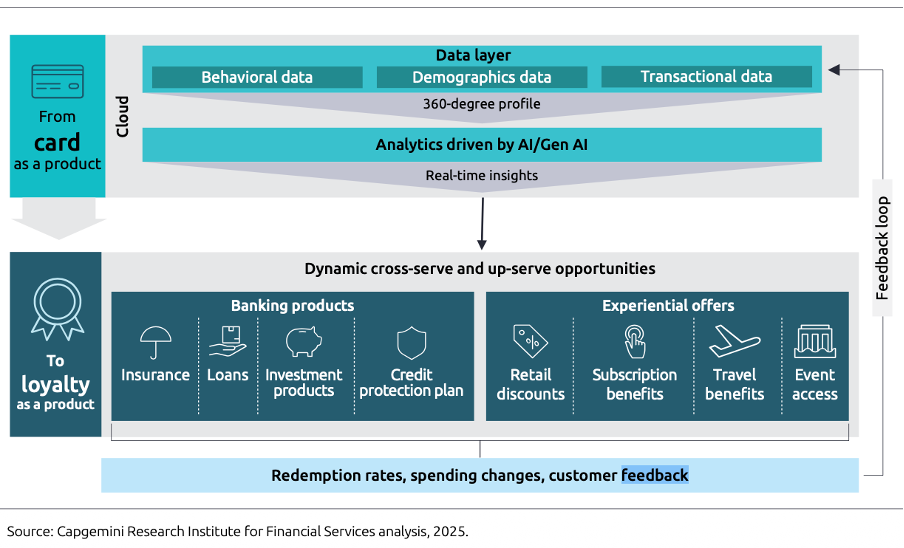
While the example is card related the concept is general for banking products:
“360-degree customer profile: By consolidating behavioral, demographic and transactional data into a unified profile, banks can gain deep insights into customer preferences and financial behaviors. This comprehensive understanding forms the foundation for targeted engagement.
AI-powered analytics: Leveraging AI and GenAI enables real-time data processing and advanced segmentation. This empowers banks to indetify customer needs dynamically and deliver timely, relevant solutions that resonate with individual expectations.
Dynamic corss-serve and up-serve opportunities:
- Banking products: Personalized recommendations for loans, insurance, investment product, and credit protection plans tailored to each customer’s financial journey.
- Experiential offers: Extend the value proposition with retail discounts, subscription benefits, travel perks, and event access designed to align with customers’ lifestyle and aspiration.”
Accenture provides a different example for external offers to be included in the cross-serve and up-serve opportunity:
“The greatest opportunity may be small-business customers, which invariably complain that generic services are poorly suited to their particular needs. Often, small-business owners are forced to glue together the capabilities they need. Imagine a future where small-business services are integrated seamlessly and capabilities - such as acquiring, payroll services, accounting and tax integration - can be turned on and off simply by clicking a button on a mobile app.”
Personas, personalization, and picking-and-choosing
Where the two reports differ most is in how concretely they picture the customer doing the choosing.
Capgemini builds its case around named personas - customers with different goals, financial situations, and channel preferences — as a device for showing why a single standardized product can't serve all of them well. It then shows how modular product features (loyalty structure, fee tiers, virtual card options, family add-ons, interest rates, FX terms) function as a menu customers can effectively mix and match, rather than a fixed bundle. The report's explicit advice to banks is to be flexible and generous with these combinations rather than defaulting to one-size-fits-all packaging.
Accenture extends this into full personalized bundling: rather than offering the same standard product package to everyone, banks could let customers assemble individualized packages with tailored terms and subscription-style incentives, similar in spirit to how Amazon Prime or leading neobanks bundle value today. A level of customization historically reserved for large corporate clients now becoming viable for much smaller relationships.
Both reports also point to democratization as a secondary effect: customer-first data and AI capabilities make it more economical to offer genuinely tailored advice to segments - mass affluent customers, small businesses - that previously only had access to generic, mass-market service, while the most sophisticated advisory experience was reserved for the wealthiest clients.
2) Change in customer service
Accenture describes customer-centric customer service as ”[b]anks’ interactions with customers will be tailored and to the point.”
“No more choosing from a list of telephonic options, waiting for an agent to become available and then being transferred, repeating personal details over and again, and then still struggling to get the required information. And no more futile interactions with today’s breed of chatbots, which are rated by customers as the least satisfying of all current bank engagement channels: 29% are “very satisfied” with them, compared to 60% for mobile apps, 50% for branches and 42% for telephone calls.”
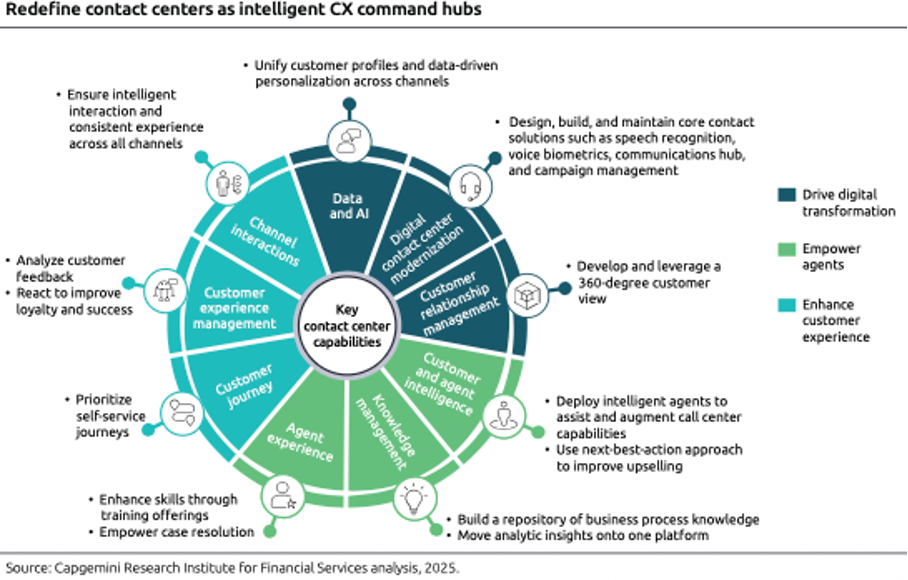
While Capgemni recommends to “[b]uild capabilities to transform contact centers into communication command centers” so that “contact centers [can] handle high volumes of customer interactions efficiently, while also ensuring that these interactions are meaningful and personalized.”
This will require “deploying intelligent agents [who] can assist human representatives by offering next-best-action recommendations, streamlining resolutions, and improving upselling potential. These capabilities allow contact centers to shift from reactive problem-solving to proactive value creation, ensuring every interaction adds to the customer’s experience.”
What does “customer-centric” need?
Neither report treats the move towards “customer-centric” as primarily a marketing or design exercise. Both are explicit that customer-centricity is, underneath, a data architecture problem.
As Accenture states it: “Banking ecosystem providers are grappling with two challenges. The first is how to incorporate AI into their offerings to help banks unlock the power of their trapped data. The second is how to modernize their often-monolithic architectures to serve a banking industry that demands more composable banking services.”
Delivering on a "bank of one" requires restructuring data around the customer rather than around individual products or the legacy systems that support them. That includes building integrated risk engines that can see a customer's full position across products, which both reduces a major source of customer frustration (having to re-explain your situation to every department) and enables offers and terms that are actually tailored to a real, current picture of the customer.
Capgemini describes the same shift from the personalization side, through what it calls micro-segmentation. Rather than grouping customers into broad demographic buckets, banks are increasingly able to segment based on detailed behavioral traits and actions - a capability that AI has made scalable in a way it simply wasn't a decade ago. The report's clearest articulation of this is a move toward continuous, real-time, hyper-personalized engagement rather than static segments that get revisited annually.
Accenture describes the setup of the future like this: “Centralized data: Bringing together data from various customer touchpoints – including mobile app, billing platforms, payment systems, credit bureaus, public records and contact centers – into a unified customer experience hub ensures that all recent interactions are accessible in on place. By providing a 360-degree view of customer events, this layer lets the bank identify critical issues and deliver prompt, informed support.
Applied intelligence: AI and machine learning models annalyze real-time customer data to prioritize needs. For example, if a customer application attempt is flagged as a high priority, it indicates that immediate action is required. Insights from this analysis will help the bank address current issues and proactively predict future needs […] Over time, the intelligence layer refines predictions and responses, continuously enhancing service with each interaction.”
While at its core the change is driven by technology, both Accenture and Capgemini raise the need for employee development.
As Accenture puts it, “the technology […] will dramatically change how banking is done, automating most if not all routine tasks and helping virtually everyone in the organization work more productively, accurately and effectively.
But like the spreadsheet, it can only do so much on its own. Soon after its launch, it became obvious that generative AI would only become a force for reinvention when deployed in close conjunction with people. This requires strong, visionary leadership, a change in mindset and culture, the reconfiguration of many traditional roles, and the development of new skills.
[…] And as most of the repetitive administrative functions are removed from people’s roles, and as AI becomes their indispensable tool, so the nature of work in the average bank will change. Bank employees will spend more time using their essentially human skills: judgement, creativity, empathy and relationship-building. The demographics of the bank will change, and along with it, its personality.
Three lenses, one direction
It's worth being precise about where the three reports emphasize different things, since none of them is simply restating the others.
Accenture's framing is largely internal and design-led: banks proactively re-architecting their own systems, teams, and product menus to put the customer's needs at the center of every decision. Its evidence base leans on behavioral and product-design detail - personas, modular features, micro-segmentation mechanics.
McKinsey's framing carries more competitive urgency: customer-centricity as a response to the fact that customers (and their AI agents) are increasingly capable of unbundling the relationship themselves, and that fintechs are already winning share of trust and satisfaction. Its evidence leans more on organizational structure and hard performance metrics - engagement lift, value lift, the customer-owner role.
Capgemini's framing is the most operational of the three: rather than describing the shift at the level of strategy or organizational design, it shows what customer-centricity requires at the level of a single product journey — the specific friction points, abandonment rates, and automation gaps that separate a bank's stated intent from what a customer actually experiences when applying for or using a card.
Put together, the three views aren't in tension so much as covering the same shift from three different vantage points: one describing what a customer-centric bank looks like on the inside, one describing why banks that don't build one are exposed on the outside, and one describing what the transition looks like at the point where a real customer interacts with a real product. None of the three reports frames this as an all-or-nothing cliff edge for laggards — all treat it as a multi-year transition, with the winners being the institutions that build the data, organizational, and product flexibility to compete on personalization rather than assuming distribution alone will hold customers in place.
What this means in practice
For banks translating this into action, a few threads run through all three reports:
- Data before design. Personalization at scale is a data architecture problem before it's a product or marketing problem. Static, product-siloed data won't support real-time, customer-level decisioning.
- Modularity over monoliths. Products increasingly need to function as components that can be combined and priced per customer, rather than fixed packages sold as-is.
- New ownership models. Organizing around "customer owners" rather than purely around product lines is a structural, not cosmetic, change - and one that affects incentives, reporting lines, and how success gets measured internally.
- Underserved segments are the biggest opportunity. Small businesses and mass-affluent customers, historically stuck with generic products, are where personalized bundling has the most room to create new value rather than just redistribute existing revenue.
- Journey-level friction is where strategy meets reality. Capgemini's data is a reminder that even a well-designed customer-centric strategy fails if onboarding, servicing, and rewards aren't rebuilt at the same time - 47% of customers abandoning a card application midway isn't a strategy problem, it's an execution one.
- Speed matters as much as sophistication. The banks capturing measurable engagement and value gains are the ones running continuous testing and iteration, not the ones with the most elegant one-time segmentation model.
The shift from product-centric to customer-centric banking isn't a single initiative a bank can complete and check off. It's a change in what the organization treats as its core unit of value - from the strategic architecture Accenture describes down to the individual card journey Capgemini lays out. All three reports suggest that the institutions treating this as infrastructure work now, rather than a future nice-to-have, are the ones already seeing it show up in engagement, conversion, and value metrics today.

.jpg)